An unlikely wildlife haven on controversial Guantanamo Bay
An unlikely wildlife haven on controversial Guantanamo Bay:- It’s an April evening on the island of Cuba, and Peter Tolson is scrambling up a wet ravine in the dark. Tree frogs and rain frogs croak and chirp while Antillean nighthawks chitter overhead. A slice of Caribbean sky is visible between the trees lining the streambed, and an oversize firefly winks against the stars.
With the help of a battered headlamp, Tolson spots a large electric-green lizard snoozing on a branch above the intermittent stream. It’s a Smallwood’s giant anole, which is endemic to this island, meaning it occurs no place else in the world. Tolson finds several smaller anoles also resting on twigs. But these are not the reptiles he is looking for. Tolson is tracking snakes. Recent rains mean there is water in the streambed, and he’s hoping some boas will come down from the hills to drink.
Tan and fit from his hours afield, with close-cropped salt-and-pepper hair, Tolson moves nimbly, with the enthusiasm of a teen, though he is 72 years old. He’s been chasing snakes for five decades in this spot. “This is a very snakey place,” he says, noting that he’s caught “about 10 boas in this little streambed.”
The snakes he seeks are thick and muscular and can reach 15 feet long. They, too, are endemic to Cuba. And they are thriving in a seemingly improbable place: the 45 square miles under United States jurisdiction known as Naval Station Guantanamo Bay. This controversial military base, with its secure perimeter and protective regulations, has become a de facto wildlife refuge, a haven for rare species.
Outside the fence line, noisy debate continues over the U.S. presence on Cuban land and the ethics of using Guantanamo to detain terrorism suspects. Inside the fence line, biologists steadily go about their work, studying the rare wildlife on the base and in its coastal waters. In the untamed corners of Guantanamo, and even among the razor wire and abandoned bunkers, these scientists find wild, unexpected beauty.
Tolson, who grew up near Cleveland and developed an early interest in reptiles, was deployed to Guantanamo as a young Marine in 1968. He’d read about Cuban boas, the island’s largest snakes, so when he wasn’t serving as a radio operator, he was out searching for them. “Every spare minute, man, if I had time off, I was up in these hills looking for stuff,” he recalls. “It kept me out of trouble.” It took him six months to find his first boa, hanging on the trusses under the Guantanamo River bridge. “It was a huge thrill,” he says.
When Tolson found other unusual reptiles he could not identify, the base librarian directed him to journals of herpetology (the study of amphibians and reptiles), and he began corresponding with the editors. Eventually, he connected with Albert Schwartz, an American herpetologist who had worked extensively in Cuba before the revolution. Schwartz made two trips to Guantanamo to search for reptiles with Tolson and encouraged him to consider a career in the field.
Tolson left the Marines after his tour at Guantanamo and attended Michigan State University on the GI Bill, earning a BS in zoology. Then he received a PhD in biological sciences from the University of Michigan. Meanwhile, he took a job as curator of reptiles at the Toledo Zoo, eventually becoming the zoo’s director of conservation and research. Since August of last year, he has served as director emeritus of conservation and research at the zoo.
Over the years, Tolson has written dozens of papers, and his research has taken him to Jamaica, Haiti, the Dominican Republic, the Turks and Caicos Islands, Puerto Rico and the Virgin Islands. While studying snakes on the Bahamas once, he wore one of his young daughters in a baby carrier. All along, Guantanamo has continued to be the center of his curiosity and, often, his research.
Tolson finds no snakes lurking in the dark streambed. So he retrieves his radio gear from a four-wheeler and walks up a dirt road to a knoll. He sweeps the landscape with a handheld antenna and listens for the clicks that will identify one of his snakes. He is currently tracking 28 Cuban boas, each carrying a radio transmitter, in an effort to determine how many individuals are necessary for a sustainable population. He’s been following the snakes for 14 years, visiting twice yearly.
It’s an ambitious study. Tolson — one of a handful of scientists who receive military permission to visit the base independently each year — wants to understand how many snakes survive in each age class. Developing a comprehensive life table will show the trajectory of a population. This has implications not only for the conservation of boas at Guantanamo, but also for their cousins dispersed throughout the Caribbean.
With its healthy population of snakes, good infrastructure and supportive military administrators, Guantanamo is uniquely suited for this research. Indeed, the boas are threatened in the rest of Cuba, where farmers kill them because they sometimes prey on chickens.
Tonight, there are no clicks for Tolson. He estimates it takes him 40 hours of searching to find a new snake and says it can even be difficult to locate those carrying transmitters. The snakes move around, occasionally hanging out in old bunkers, tunnels or pipes, which obstruct the signal.
But driving down from the hills, Tolson spies a young Cuban boa lazing on the pavement in the dark, soaking up the residual warmth. Tolson pulls his four-wheeler to the shoulder and gently scoops up the skinny snake, which is more than two feet long. Curled in his hands, it’s a magnificent creature, quite slender, its back covered with chocolate and tan patterns. He places it in a plastic tote in the bed of his vehicle.
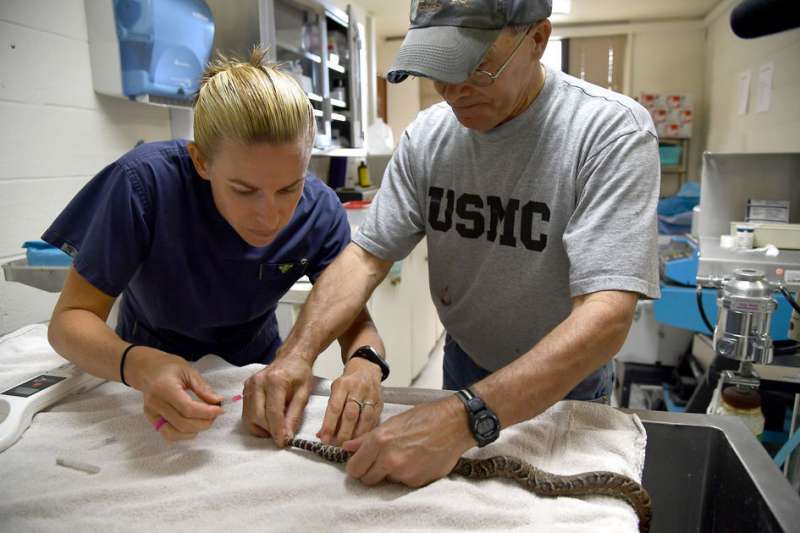
The next morning, he takes the snake to a veterinary clinic. Dogs yap from their kennels, and the veterinarian, Army Capt. Brittany Marble, looks busy. But she is pleased to see Tolson and, especially, the snake.
“How old is he?” Marble asks.
“He’s young-of-the-year,” says Tolson, meaning the snake was born this past fall.
Marble pulls out a plastic box labeled “snake set.” Tolson helps hold the snake as Marble injects a bit of numbing lidocaine near its tail. Then, using an oversize hypodermic needle, she inserts a tiny electronic tag, not much bigger than a short length of pencil lead, that will allow them to identify the snake if it is recaptured. (This is smaller than the radio transmitters implanted in the snakes Tolson is tracking; he already has his hands full with 28.) Tolson identifies the sex of the snake by gently probing its cloaca, an opening near the end of the tail for both the digestive and reproductive organs. It’s a female.
Marble is new to snake work — in vet school she focused on horses, dogs and cats — but it has become a passion. “I’ve learned a lot, and I really, really like snakes,” she says. “It’s my favorite part about being here.”
Once, when Marble and her husband were out jogging, pushing their year-old twins in a stroller, they came across a huge, slightly injured boa in the road. Marble grabbed her husband’s T-shirt and wrapped it over the snake’s head to keep it calm. Then they picked up the snake and set off jogging the two miles to the vet clinic. Marble held the boa’s head as it draped across her shoulders and rested part of its writhing, 35-pound body on the stroller; her husband ran alongside holding the snake’s tail.
The snake had a facial injury, which Marble treated with antibiotics. Then she gave it a transmitter and released it. Now it’s in Tolson’s study.
Tolson and Marble measure the young snake and weigh it on a cat scale — 31 inches, eight ounces — and log the details in a notebook. Then Tolson takes it to a nearby ridge to release it. Up on the hill, the Caribbean sun bakes down. A curlytail lizard basks on a post. A Cuban pygmy owl perches in a nearby shrub, its breathy calls competing with the muted cracks of rifle shots from a distant target range. Down below sprawls the naval base, a small town on the shore of placid, blue Guantanamo Bay.
Source:-https://www.washingtonpost.com/lifestyle/magazine/how-controversial-guantanamo-bay-became-an-unlikely-wildlife-haven/2017/07/10/b2a31192-578e-11e7-b38e-35fd8e0c288f_story.html?utm_term=.36ce84cebce6