Home






Candidates
|
Political Parties
|
US State Candidate
|
Congressional Candidates
|
Campaign Buttons
|
The Presidency
|
Election Calendar
|
Awards
Share the joy


Latest News
Politics
11 May 2018
EPA chief Pruitt's ethics issues have raised concerns: White House
Politics
11 May 2018
Key senator urges any wavering U.S. high court justice to retire now
Politics
11 May 2018
White House official mocked 'dying' Senator McCain: media
Politics
11 May 2018
Lawsuit against U.S. border searches of phones can move forward: judge
Politics
11 May 2018
Ex-Illinois congressman sentenced to prison on tax charges
Politics
11 May 2018
Trump administration to reconsider housing bias protections
Politics
10 May 2018
Companies detail payments to Trump lawyer; Daniels' attorney says there's more
Politics
10 May 2018
Concerns over U.S. court backlog grow with rising border prosecutions
Politics
10 May 2018
Trump's CIA pick promises no more harsh interrogation program
Politics
10 May 2018
Cheney, Panetta worry about consequences of Iran deal withdrawal
Politics
10 May 2018
Rebel House Republicans seek to force 'Dreamer' immigration vote
Politics
10 May 2018
3 Americans Freed From North Korea Arrive Near Washington
Politics
5 Oct 2016

Trump not walking the walk on his tax claims


Trump not walking the walk on his tax claims,Barack Obama,Hillary Clinton,US Elections 2016,Donald Trump,US Presidential 2016 Elections,Polls,Campaign
Trump not walking the walk on his tax claims
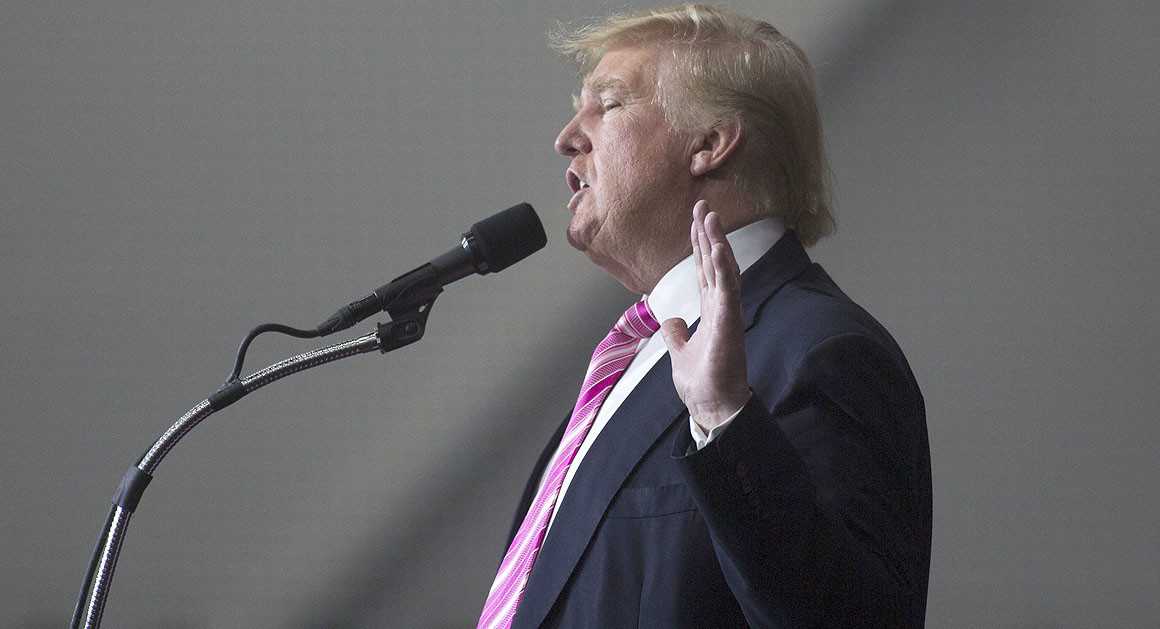
Trump not walking the walk on his tax claims : Donald Trump, under fire over his taxes, is casting himself as a champion of the little guy when it comes to rewriting the tax code, but there’s little in his plan that matches his rhetoric.
His promises to stick it to the rich notwithstanding, independent analyses agree the top 1 percent would be the biggest beneficiaries of his plans to cut individual, business and capital gains rates.
Though his plan would dole out more than $4 trillion in tax cuts, one study found Trump would actually raise taxes on 8 million low- and middle-income Americans.
And while Trump has railed against the special-interest provisions that pock the tax code, he’s sought to protect breaks important to real estate, the bedrock of his business and one of the most lavishly subsidized industries in the code. Among them: a deduction for interest expenses critical to real-estate developers like himself.
“I don’t think there’s any connection between the rhetoric and what he’s actually proposed,” said Len Burman, head of the centrist Tax Policy Center. “What he’s actually proposed would benefit people like him.”
That sort of sharp difference between what Trump says his tax plan would do and how experts say it would shape tax law has endured throughout the campaign, even as Trump rolled out several versions of his tax reform plans.
But that gap has taken on new urgency after leaked documents from his 1995 tax return show he took a massive $916 million loss that he may have used to avoid paying federal taxes, perhaps for as long as 18 years. Many experts suspect those losses were generated in part by savvy use of tax breaks, particularly for the real estate industry.
Trump has done nothing to dispel that notion, and in fact may be fueling it. In the wake of the New York Times report, Trump has portrayed himself as a shrewd manipulator of the tax code who’s now going to use his hard-won expertise to create justice for average Americans.
“The unfairness of the tax laws is unbelievable,” Trump said at a campaign stop this week. “It’s something I’ve been talking about for a long time despite, frankly, being a big beneficiary of the laws. But I’m working for you now. I’m not working for Trump. Believe me.”
Though he’s heralded plans to go after so-called carried interest, a tax loophole important to wealthy money managers, as evidence of his willingness to turn on the rich, experts say the sting of those changes would be swamped by his other tax cuts.
The top 1 percent would see their after-tax incomes go up by as much as 19.9 percent, according to the conservative-leaning Tax Foundation, more than twice what it projected for those in the middle one-fifth of the income scale.
The Tax Policy Center, reviewing a previous draft of his plan, came to a similar conclusion. The top 1 percent would see an average tax cut of $275,000, the group said, compared with $2,700 for those in the middle of the income spectrum.
Some average Americans would actually see their taxes go up under Trump’s plan, according to an analysis by Lily Batchelder, a former Democratic tax aide now teaching at New York University, whose conclusions were seconded by the Tax Foundation.
That’s because Trump wants to junk personal exemptions as well as the head-of-household filing status, which subsidizes single parents. Trump would simultaneously expand the standard deduction they take, but for some, the losses would outstrip the gains, said Batchelder.
It’s become a major issue in the campaign, with Hillary Clinton — who’s called for big tax hikes on the rich — lambasting Trump’s plan.
“The kind of plan that Donald has put forth would be trickle-down economics all over again,” she said in the first debate. “Slashing taxes on the wealthy hasn’t worked.”
The gap between what Trump says his tax plan would do, and what it would actually do, began more than a year ago, when he first released his plan. Many observers were surprised when Trump, after railing against carried interest and other perks for the wealthy, produced a fairly conventional Republican tax plan. He proposed dropping carried interest as promised, but analysts agreed it was still a top-heavy plan.
Chastened by the analyses, as well as complaints over the plan’s costs, Trump revised his plan, promising to focus more of its benefits on average Americans.
“The tax relief will be concentrated on the working and middle class taxpayer,” he said last month. “They will receive the biggest benefit — it won’t even be close.”
Trump backed off some of his initial proposals, dialing back plans to cut the top marginal tax rate, for example, and proposing new limits on top-earners' tax breaks, such as cracking down on their ability to pass capital gains on to heirs tax-free.
But the new plan is still tilted toward the rich, the Tax Foundation said. The Tax Policy Center plans to release its analysis of his revised plan next week.
Of course, it’s hardly surprising that a Republican tax plan would mostly benefit the wealthy. They’ve become increasingly boxed in by a tax code that’s quietly become the most progressive it’s been in at least a generation, in part because of tax hikes pushed through by President Barack Obama.
The top 1 percent paid 25.4 percent of all federal taxes in 2013, according to the nonpartisan Congressional Budget Office, and the top 10 percent paid 69 percent of all taxes.
The middle one-fifth paid 8.9 percent, the agency said in a June report, and those in the bottom fifth of incomes paid 0.8 percent.
“It’s hard to avoid,” said Ryan Ellis, a Republican tax consultant. “Any time you want to cut taxes, almost by definition it is going to be a fairly regressive tax cut because the taxes that are left to cut tend to be concentrated at the top.”
What’s more, Clinton has largely ignored the issue of tax reform. If anything, experts say her plans to raise a host of taxes on the rich and give several targeted tax breaks to the middle class would make the code more complicated. Said Ellis: “I don’t get the sense she’s the least bit interested in tax reform.”
But some note that Trump — even as he says his experience in real-estate tax matters makes him uniquely qualified to tackle a tax-code rewrite — has proposed little in the way of reforming the breaks from which he’s benefited.
“He’s made a big deal in the last week about how we knows all about how people like him take advantage of tax laws, but I don’t think he has any specific provisions that would change the way we tax real estate,” said Burman. “He certainly hasn’t proposed anything that would hurt people like him.”
Source :
Http://www.politico.com/story/2016/10/donald-trump-tax-claims-229126
You May also Like